Tuesday, September 20, 2011

Philadelphia's Famous Son: Benjamin Franklin

Who is this man on our one hundred dollar bill? Why has he been honored this way?
This same man used to be on our half dollar. Did you guess Benjamin Franklin? Because of his many achievements, Franklin is one of our best known founding fathers.

Benjamin Franklin may be Philadelphia’s most famous citizen. Born the fifteenth child (of seventeen children) to working class parents in Boston, Franklin had only two years of formal schooling. Without wealth, privilege or an excellent education, his prospects for success seemed minimal. However by the time Franklin died at the age of 85 he had achieved so much it seems almost impossible that one man could accomplish so many things in such varied fields. A writer, a scientist, a statesman, an inventor, and a businessman, Benjamin Franklin will forever be remembered and revered.

The stove invented by Benjamin Franklin is used to heat a room.
One of the most interesting of the founding fathers, Benjamin Franklin was an innovator who spent a lifetime finding ways to improve everything he touched. His inventions were many:
·      Franklin stove
·      Bifocal glasses
·      Lightning rod
·      Simple odometer to measure distances he traveled
·      Glass Armonica—musical instrument
·      Daylight Savings Time
 

This 9-foot tall bust of Benjamin Franklin in Philadelphia was created by James Peniston. He talked to elementary students about Franklin and asked them to bring old keys from home to be used in the statue. Casts of the keys were incorporated into the surface of the bust. 

Here you can see a closeup of the keys on the surface of the bust of Franklin. Why is Benjamin Franklin associated with keys?


Franklin worked to improve the lives of those around him. He founded the first surgical hospital in the United States. The building still stands in Philadelphia. Because there was no electricity, surgery could be performed only in the middle of the day when sunlight streamed through the skylight that lit the surgical suite. Operations were free to the patient. The hospital earned money by allowing spectators, for a fee, to watch surgery performed. Other of Franklin’s achievements include these:
--Colonial printer
--Experiments with electricity
--Introduced new crops to the United States
--Started the first insurance company
--Founded the University of Pennsylvania
--Started the first lending library
--Served as first postmaster of the United States
--Writer of Poor Richard’s Almanack and other works
--Established the first fire and police departments
--Started the American Philosophical Society
--Started the Leather Apron Club, an early union
--Drew the first political cartoon in an American newspaper
--Designed a phonetic alphabet
--Began printing America’s first German language newspaper 
--Launched a project to pave, clean, and light Philadelphia streets  

America's first surgical hospital is located in Philadelphia. If you look closely near the top of the building, you can see the large oval skylight that let in light so that surgery could be performed.

Franklin's political cartoon. What does it mean? Why is the snake cut into thirteen pieces? What does each piece represent?

Benjamin Franklin may be more widely known for his work in the establishment of the United States. He was appointed to the “Committee of Five” whose job it was to draft the Declaration of Independence. While Thomas Jefferson wrote the original draft, Franklin provided much input for revisions. Saying, “We must all hang together, or assuredly we shall hang separately,” Franklin voted to accept the Declaration of Independence on July 4, 1776. For the fledgling government he served as Commissioner to Canada, Ambassador to France, and on the Committee of Secret Correspondence. He also convinced the French to support the American war effort by providing money, supplies, ships, sailors along with military leaders. At the end of the Revolutionary War, Franklin served as one of three commissioners to negotiate the terms of peace with Britain. A delegate to the Constitutional Convention in 1787, Franklin was a signer of the United States Constitution.
Franklin's glass armonica can be heard at Colonial Williamsburg. This one, played by Dean Shostak, dates to Franklin's lifetime.
  
Benjamin Franklin held more than 20 public offices. A complete list of them is at the end of this post. It is hard to believe that one man could be responsible for so much. It clearly demonstrates that others held Franklin in great esteem and had much confidence in his abilities.
 
Considering his many accomplishments is it any wonder that Benjamin Franklin was featured on one of the first United States postage stamps in 1847?


There is much, much more to learn about Benjamin Franklin. Take the time to find out about him in your school or pubic library. There also are many good Internet resources devoted to Franklin's life and time.


If you are in Philadelphia, spend a day at The Franklin Institute, an interactive museum. Here you can see many excellent science exhibits. At present there is an informative exhibition about mummies. Also, as part of the permanent collect is an exhibit about the human heart that includes a model of the heart that is so large you can walk through it. And in the exhibit about flight, there is one of the original airplanes built by the Wright brothers.


 Franklin Institute in Philadelphia

List of Public Offices Held by Benjamin Franklin:

--Clerk of the Pennsylvania Colonial Assembly
--Deputy Postmaster at Philadelphia
--Common Council of Philadelphia
--Justice of the Peace for Philadelphia
--Representative from Philadelphia to the Pennsylvania Colonial Assembly
--Alderman of Philadelphia
--Deputy Postmaster General of North America
--Commissioner to Albany Congress from Pennsylvania
--Pennsylvania Assembly's Representative to the King of England
--23rd Speaker of the House of the Pennsylvania Assembly
--2nd time Pennsylvania Assembly's Representative to the king in England
--Colonial Agent to the King of England
--Colonial Agent from New Jersey to the King of England
--Colonial Agent from Massachusetts to the King of England
--Philadelphia's Representative to Second Continental Congress
--1st Postmaster General of the United States
--Commissioner to Canada
--Delegate from Philadelphia to Pennsylvania state convention
--President of Pennsylvania convention
--Delegate to Congress from Pennsylvania Convention
--United States Minister to Sweden
--6th President of the Supreme Executive Council of Pennsylvania


Monday, September 19, 2011

Philadelphia: The City of Brotherly Love

"RELIGIOUS LIBERTY: Dedicated to the people of the United States by the Order of B'nai B'rith and Israelites of America"


Prior to the arrival of the Europeans, Philadelphia was the home of the Lenape natives. William Penn, an Englishman and a Quaker, was granted a large piece of land by the King of England and, as a result, Penn established the Pennsylvania colony. He also planned the city of Philadelphia, which means “City of Brotherly Love”. Penn wanted his colony to be a haven from religious persecution, and as a result Pennsylvania was more tolerant and had somewhat better relationships with native tribes than did other colonies. During the Colonial Era Philadelphia was the largest city and busiest port in all the thirteen colonies. Like Pittsburgh, it was established on two rivers for easy transportation—the Delaware and the Schuylkill. Its importance led to Philadelphia being chosen as the site of the establishment of the United States of America where both the Declaration of Independence and the United States Constitution were crafted.
 

Independence Hall where the Declaration of Independence and the United States Constitution were approved. The building is currently being restored and preserved.

It is awe inspiring to stand in the very room where George Washington and Benjamin Franklin, among others, worked to create the United States of America. The chair Washington sat in as he presided over the proceedings still sits in the room where this important work was accomplished. As visitors walk through Independence Hall they are stepping on hallowed ground. It is easy to picture Washington sitting in that chair overseeing the momentous events that were occurring around him.


This is the room where George Washington, Benjamin Franklin, and others approved the United States Constitution.
The large chair behind the table is the very chair that George Washington sat in when he presided over the Constitutional Convention.
 
Originally built as the state house where Pennsylvania lawmakers met, Independence Hall became the chief meeting place of the Second Continental Congress and the Constitutional Convention. Next door to Independence Hall sits Congress Hall, which served as a home for the United States Congress when Philadelphia was the capital of the United States (1790-1800). After that, Washington, D.C. was named the new capital and the government moved there. 

Congress Hall sits next to Independence Hall.
  In 1793, President George Washington was inaugurated for his second term as president in Congress Hall. Four years later the reins of power were passed from George Washington to John Adams, the first peaceful transition of government in the new country. When the ceremony ended, the new president, John Adams, waited for George Washington to exit first, but Washington insisted that the new president lead the way. Perhaps the most important thing to happen in Congress Hall was the ratification of Bill of Rights, the first ten amendments to the Constitution that provide Americans important freedoms.
 
This large clock is situated on the side of Independence Hall.
Congress met in this room, and George Washington was inaugurated for his second term as president here. The transition from President Washington to President John Adams also occurred in this room.
"I ask you ... to adopt the principles proclaimed by yourselves, by your revolutionary fathers, and by the old bell in Independence Hall." --Frederick Douglass 
Liberty Bell
Before other means of alerting citizens were invented, large bells were used because their sound could be heard for great distances. Early on, the Liberty Bell, set atop what is now called Independence Hall, was used to notify citizens of important matters and public meetings. It also was used to call legislators to sessions.

In 1752, the Liberty Bell was commissioned from the London firm of Lester and Pack. After it arrived in Philadelphia, the bell was tested, and it cracked. John Pass and John Stow, whose last names appear on the bell, twice recast it. The lettering on the bell states, "Proclaim liberty throughout all the land unto all the inhabitants thereof." The bell was used as a symbol for the women’s suffrage movement and was rung on August 29, 1920 to commemorate the signing of the 19th Amendment to the Constitution granting women the vote.


Timeline of Events Related to the Liberty Bell
1753 After arriving in Philadelphia from England, the bell was recast because it cracked while being tested.
1777 Patriots took the bell out of Philadelphia to keep the British from capturing it when they occupied Philadelphia during the Revolutionary War.
1846 Workers repaired the bell after it cracked sometime in the early 1800s. The repair was only briefly successful so the bell was removed from service.
1852 The bell was moved from Independence Hall because it could no longer ring.
1915 A “spider” placed inside the bell has kept the crack from worsening.
2003 A new building to protect, preserve, and display the Liberty Bell was constructed. The bell is now housed there.
 
Measurements of the Liberty Bell: 
--At its widest point the circumference is 12 feet.
--The bell's height is 3 feet.
--Length of clapper is 3 feet 2 inches.
--Thickness at the bottom is 3 inches.
--The bell weighs 2,080 pounds, a little more than a ton.

Sunday, September 18, 2011

It Happened First in Pittsburgh

Pittsburgh can be credited with many firsts. Here are a few:

  • In 1967 the first Big Mac was served. After being test marketed in other Pittsburgh area McDonald's, the Big Mac was available across the USA.
  •  You know the Internet smiley? :-) It's called an emoticon and was created in 1982 at Carnegie Mellon University.
  • The first night World Series game was played in Pittsburgh in 1971.

Mr. Yuk
  • Mr. Yuk was created in 1971 at Children's Hospital to warn kids that certain things are poisonous and not to be consumed.
  • In 1989 the first heart-liver-kidney transplant was performed in a Pittsburgh hospital.
  • Does your local high school participate in the robotics competition? The first one was held at Carnegie Mellon in 1979.
  • The first pull tabs on canned drinks were created in Pittsburgh in 1962. Before that you had to use a can opener.
  • In 1954 the first public TV station went on the air in Pittsburgh.
  • The polio vaccine was developed in Pittsburgh by Dr. Jonas Salk.
  • Bingo was invented in Pittsburgh in the early part of the 20th century.
  • In 1913, the first gas station opened in Pittsburgh.
  • Forbes Field in the Steel City was the first baseball stadium in the nation.
  • The first movie theater, called a Nickelodeon, was opened in Pittsburgh in 1905.
  • The banana split was invented at a drug store in Pittsburgh.
  • The Klondike Bar, a favorite ice cream treat, hails from Pittsburgh.
What other famous firsts can you find that happened in Pittsburgh? 

Are there any famous firsts in your home area?

Saturday, September 17, 2011

What Makes Pittsburgh Special

 
Would you pay $100,000,000 (one hundred million dollars) for a painting by this man? In 2009, his painting called Eight Elvises sold for that much. Who is this famous painter, one of Pittsburgh's most celebrated sons? His name is Andy Warhol. A museum dedicated to his artwork can be found in downtown Pittsburgh.


 Eight Elvises

Warhol, born in Pittsburgh, was well known for his pop art creations and his paintings of famous people. He painted everyday objects such as a Campbell’s soup can and bottles of Coca Cola. Warhol began his career as a commercial illustrator, but later gained world renown as a painter, filmmaker, record producer, and author. He lived and worked in New York City and was a prolific artist. Sadly, Warhol died at a relatively young age in 1987.


 This Warhol painting sold for $9,042,500.
 

Perhaps you recognize this fellow. Warhol painted Michael Jackson in 1984, and it appeared on the cover of Time Magazine on March 19 of that year. Time then donated the painting to the National Portrait Gallery in Washington, D.C. where everyone can enjoy it.

This statue honors a very special man who also was from Pittsburgh. Fred Rogers  was a man of many talents. In addition to being a minister, he also was a songwriter, an educator, and the television host of Mister Rogers’ Neighborhood. He was dissatisfied with television programming for children. As a result, Mr. Rogers began to write and perform for children on local Pittsburgh television shows. Then, in 1968 PBS worked with Mr. Rogers to develop his own television show. At the beginning of each show, Mr. Rogers changed his shoes and put on a sweater. This became the basis for the statue that honors him. Mr. Rogers’ Neighborhood aired until 2001 and can still be seen in reruns.
 

In this photo you can see two rivers joining to create a third river at the Point in downtown Pittsburgh. The one on the left is the Allegheny and the one on the right is the Monongahela. Where they join the river becomes the Ohio.    
 

As you travel around Pittsburgh, you begin to notice many, many bridges. You can see in the picture above several of them. Altogether, there are several hundred bridges in The Steel City. This makes Pittsburgh the city with the most bridges in the world!

Part of Pittsburgh is high atop Mt. Washington. One interesting way to reach the top of the bluffs overlooking the city is to ride the Duquesne Incline. You can see the red cable car in the photograph above. At one time there were 18 of these cable car lines along the Monongahela River that carried both passengers and goods. Today only two remain. The view from the top is spectacular. You can see for miles and get a grand overview of the entire downtown district.  
 
No matter where you travel you can find interesting food, and Pittsburgh is no exception. Here are a few dishes that earned rave reviews ...   
 
 A tasty Italian sub
 
 Delectable catfish over grilled onions and red peppers above a bed of mashed potatoes
 
 A Primanti Brothers special sandwich, originally designed in the 1930s for mill workers. It is a meal that includes grilled meat, coleslaw, tomato, and French fries piled high on an Italian roll. Yum!
 
 Lobster bisque (soup)  
 
Seafood Trio--macadamia crusted shrimp with mango sauce, grilled salmon, and a crab cake with rice and steamed vegetables.
 
Also food related is this fellow, a dinosaur shaped Heinz Ketchup bottle:
Pittsburgh is the home to both Heinz and Del Monte food companies. With which Heinz and Del Monte products are you familiar? You can find many products by both companies at your grocery store.

Friday, September 16, 2011

The Steel City


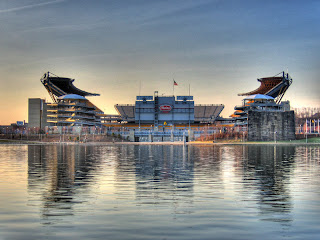
Until ten years ago, Three Rivers Stadium was the home of one of the most successful teams in the NFL.


What NFL team has won six Superbowl titles, eight AFC Championship Games and played in fifteen conference championship games, more than any other AFC or NFC team? This team shares with the Dallas Cowboys the record for most Super Bowl appearances.

If you guessed the Pittsburgh Steelers, you are right. Named for the city that is known for its many bridges and former steel manufacturing, the Pittsburgh Steelers have a huge fan base named best in the NFL largely because of 299 consecutive sold-out games.


Now the Steelers play at Heinz Field. (Does the Heinz name ring a bell? For what is this family known?)

So, what does steel have to do with Pittsburgh? Look at the three photographs below. Each depicts the same geographic location. Examine the first picture closely. What do you see? What does it say about the economy of Pittsburgh in the past? What is happening in the second picture? How does it show a changing economy? Consider the third photograph. Can you see that it illustrates a new use for the land? Now a shopping district with many stores and restaurants, the area provides goods and services where consumers can spend their money.

This is a Pittsburgh steel mill with smoke stacks belching. Thousands and thousands of workers were employed here. The mill stayed so busy producing steel for automobiles and construction goods that three shifts of workers toiled around the clock. The factory operated for decades, and people relied on the income derived from working there.

In the 1980s the steel industry collapsed, and the steel mill closed. It was cheaper to produce steel in other countries. Jobs shifted overseas and foreign workers took over the creation of steel. The steel mill on this site was torn down but the large smoke stacks were preserved. You can see them to the left of the photograph. The smokestacks now serve a new purpose, to remind people that at one time in Pittsburgh steel was king.

In the 1990s, the area was reclaimed for a new purpose. It now houses a large shopping district with a multitude of stores and restaurants. The smoke stacks are still there. Which photo do you believe illustrates the most job opportunities? Why? What happens to a community when its economic base collapses? Is the economic base in your community changing? If so, how?


Ft. Pitt
When European settlers established communities in the 1600s, the quickest transportation was by water. Because of this many cities across America grew up on rivers. Pittsburgh is one such city. Established where the Monongahela and Allegheny Rivers join to form the Ohio River, Pittsburgh has a long and important history. In the early days, Fort Pitt, constructed during the French and Indian War, sat at the tip of a triangular piece of land bordering the confluence of the two rivers. All that remains today is the Block House, constructed by the British in 1764. Native tribes tried to reclaim lands taken from them by Europeans but were unsuccessful.


The Block House served as a redoubt for Ft. Pitt.

Today Pittsburgh bustles with activity. Its economy is largely based on healthcare, technology, education, robotics, and financial services. Long gone are most of the steel mills for which the city was widely known. There is a mix of new architecture among the old. The photographs below illustrate this and also show a few sights one can see while strolling along the city streets.


Wednesday, September 7, 2011

Northeast Region, Here I Come!

Next week my travels will take me to New York, Philadelphia, Boston, and Pittsburgh. I'm filled with excitement as I think about all the wonderful experiences I will have. Perhaps a Philly Cheese-steak sandwich is in my future ... or a trip to a show on Broadway ... or a visit to Three Rivers Stadium ... or a stop by Boston Harbor where the colonists dumped tea ... or a look at Independence Hall where the Second Continental Congress was held and the Declaration of Independence was approved. There is so much to see and do in this region of our great nation. Stay tuned to learn more about each of these important cities.

Look at the pictures below. Which city is New York? Which is Boston? Philadelphia? Pittsburgh? What clues help you decide? (Answers at the bottom)


Pittsburgh, Philadelphia, Boston, New York